Four ways we close the integration gap
From hands-on integration builds to the advisory work that comes before them.
Your ERP shouldn't be an island
We connect ERP systems to the third-party platforms they need to talk to: product information management (PIM), warehouse management (WMS), ecommerce and company websites, EDI with vendors and partners, and the reporting and BI tools finance and operations depend on.
Dynamics GP is where we go deepest. We fully understand its data model, its quirks, and how to integrate around them without disrupting daily operations.
This isn't an exhaustive list. Our integration approach doesn't depend on having prior experience with a specific ERP: if it exchanges data, we can integrate it.
Any system, any protocol
Beyond ERP-specific work, we build point-to-point and platform integrations using REST APIs, GraphQL APIs, SFTP file transfer, webhooks, queue or event-based architectures or whatever fits the systems, volume and need involved.
Real-time dropship stock sync
A client's dropship vendor holds live inventory counts that need to reflect on the storefront within minutes, not overnight. We built a webhook-driven pipeline that picks up vendor stock changes as they happen, cleans and standardizes the incoming data (units of measure, pack sizes, duplicate feeds), validates it against expected ranges and formats, and maps vendor SKUs to the client's product catalog before posting updated availability to the storefront. Records that fail validation are flagged for review instead of posted, so the site never shows stock that isn't real.
The result: no more overselling out-of-stock items, no manual spreadsheet reconciliation, and a clean audit trail when something needs a human look.
Bespoke software, built to fit
When off-the-shelf tools don't cover a specific operational gap, we design and build the software to fill it, for clients, and for ourselves. Mettl, our in-development vendor invoice automation product, is a direct example of the kind of solution we build.
See Mettl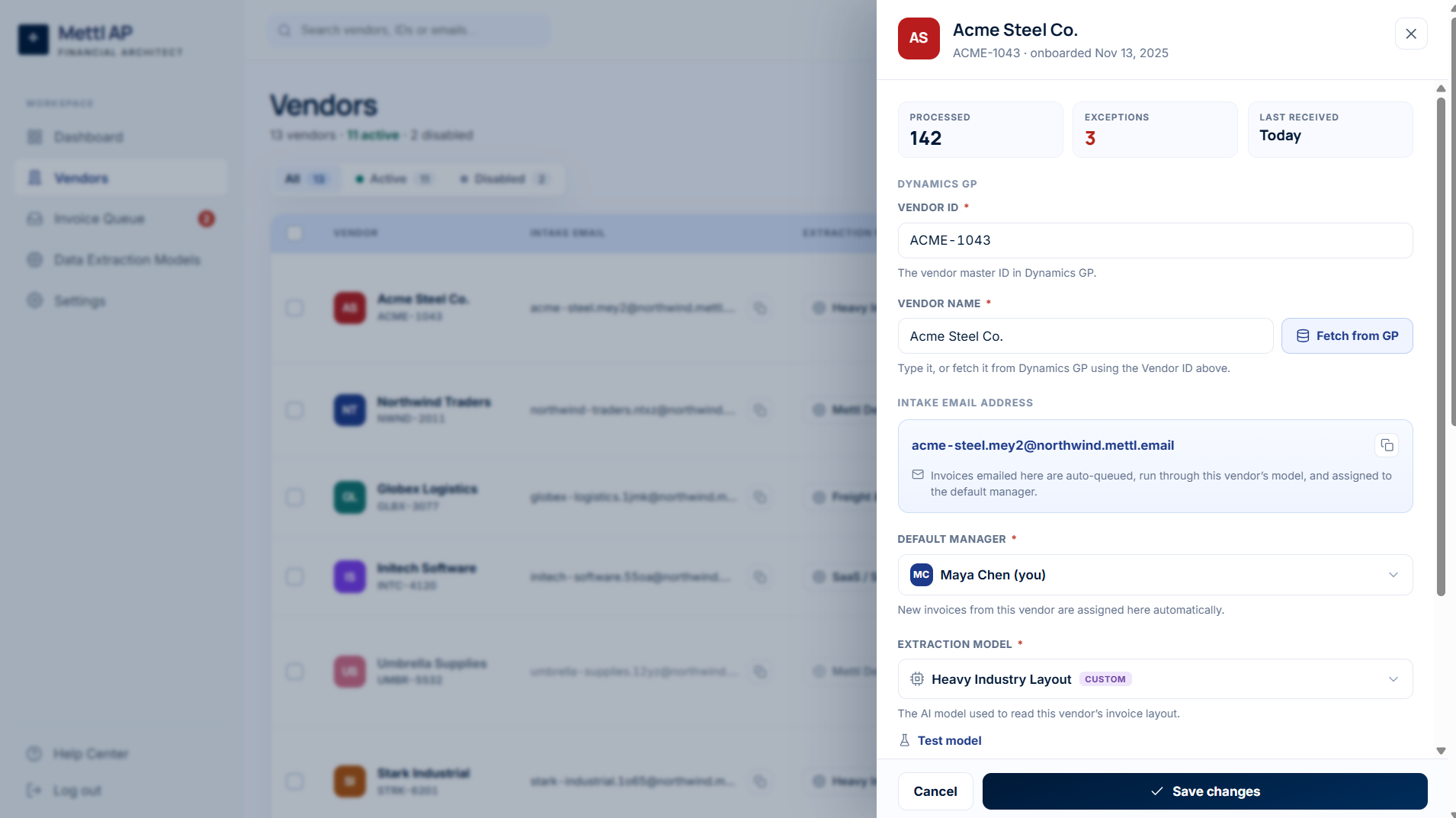
Advisory before you build
Not every engagement should start with a build. We work with finance, IT, and operations leaders on ERP strategy, integration architecture reviews, and vendor or build-vs-buy evaluations, so decisions get made with a clear picture of cost, risk, and fit before any code is written.
ERP strategy
Aligning your ERP roadmap with where the business is actually headed.
Integration architecture review
A clear-eyed look at what's brittle, what's redundant, and what's missing.
Vendor & build-vs-buy evaluation
Structured comparisons so the decision holds up under scrutiny later.